

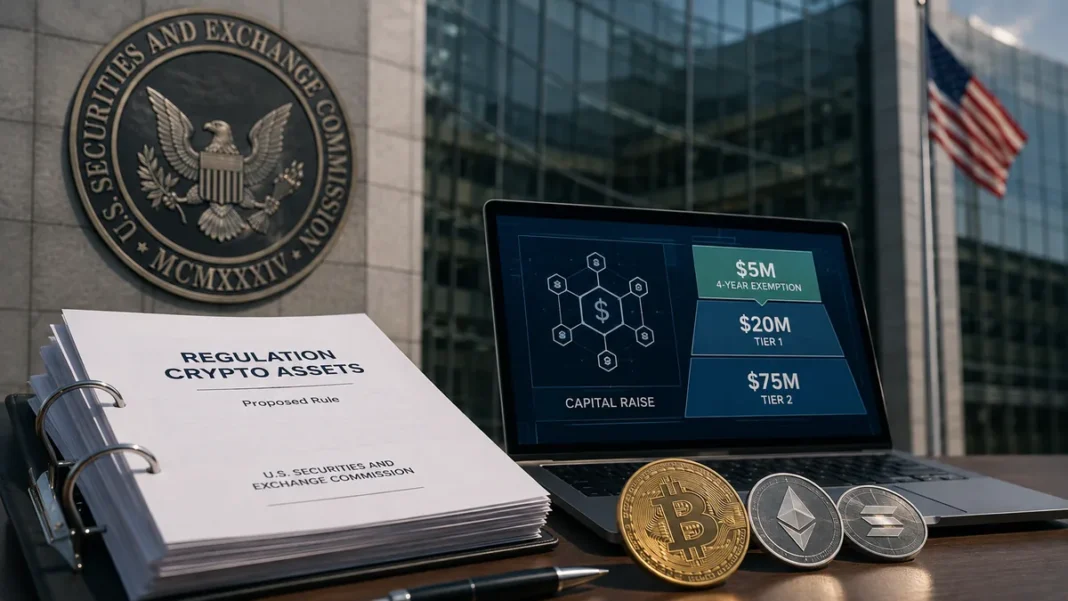
Crypto projects raising money in the United States would get a dedicated set of rules under a proposal the Securities and Exchange Commission published on August 21. Regulation Crypto Assets creates two new exemptions from Securities Act registration and, for the first time, a formal process for a crypto asset to stop being treated as part of an investment contract once specific conditions are met.
Public comment is open until October 20, and the rule has not been adopted. Until it is, none of what follows applies to an actual offering.
Two ways to raise money without registering
One exemption would let eligible issuers raise up to $5 million over a four-year period. The other splits into tiers: up to $20 million under Tier 1 and up to $75 million under Tier 2, both measured over a 12-month period.
Neither route is new territory the SEC is inventing from scratch. What’s new is applying it to crypto specifically, and that’s where most of the proposal’s length comes from.
A Chain Pakistan review of the SEC’s proposal, which runs to more than 400 pages, found that the fundraising limits are the smallest part of the document. Most of it deals with how issuers disclose project development, report after an offering closes, and eventually establish that the investment contract around a token has ended.
Existing securities rules weren’t built for that last part. Traditional securities rules generally assume that the security remains a security throughout its life. A crypto asset does not always fit that model: an issuer raises money promising to build a network, and years later the network exists and the promises are fulfilled, but the underlying rules never accounted for that kind of exit.
Regulation Crypto Assets is the SEC’s attempt to build one.
The $5 million route, for projects just getting started
Four years and $5 million is the ceiling for the smaller exemption, and an issuer can only use it once for the same or a substantially similar asset.
That last condition matters. Without it, a project could reset the clock by making cosmetic changes and effectively raise indefinitely under a rule meant for early-stage development.
The proposal also contemplates transactions beyond a straightforward token sale. Certain airdrops, staking-related distributions, governance incentives and payments tied to operating or testing a network could qualify when the exemption’s conditions are met.
Issuers still have to tell the SEC they’re relying on the exemption, filing a notice on a new Form NOR along with the information the regulation requires.
What they don’t have to do is meet the financial statement requirements attached to the larger exemption. That’s a deliberate tradeoff: lower capital ceiling, lighter paperwork.
Getting to $75 million comes with real obligations
Modeled partly on Regulation A but built specifically for crypto, the larger exemption runs in two tiers.
Tier 1 caps offerings at $20 million in a 12-month period, including limits on how much affiliated selling holders can contribute. Tier 2 goes up to $75 million.
None of that comes free of filing requirements.
Issuers using either tier would have to submit a new Form 1-CRYPTO, covering the issuer, the offering itself, the associated network or application, development plans and financial condition.
Financial statements come with it too, though not identically across tiers. Tier 1 issuers don’t face a mandatory audit requirement, though an existing qualifying audit still has to be filed, while Tier 2 statements would need a full audit under standards the proposal specifies.
Reporting doesn’t stop once the money is raised, either.
Both tiers carry ongoing reporting obligations, including annual, semiannual and current reports on new SEC forms. That’s a real departure from how Regulation A works today, where Tier 1 issuers generally don’t face continuing reporting at all.
The SEC’s justification is specific to crypto: a network’s continued development can keep mattering to the value of the investment contract long after the offering closes, in a way that isn’t usually true of a traditional securities issuance.
When the investment contract can end
The proposal’s most consequential piece may be the part with the smallest dollar figure attached to it: the investment contract safe harbor, set out under proposed Rule 400.
To use it, an issuer has to complete or permanently stop the “essential managerial efforts” it originally promised, and it can’t turn around and promise new ones for the same asset.
If those conditions are met, the issuer would file a transition report on Form TR, identifying the asset, certifying that the conditions are satisfied and explaining why the investment contract has ended.
If those conditions are met and the required Form TR is filed, the asset would no longer be treated as subject to that investment contract under the Securities Act or Exchange Act definitions of a security.
That’s a narrower test than asking whether a network has become “decentralized.” It turns on one specific question: has the issuer’s promised work actually stopped?
Filing Form TR doesn’t settle the question permanently, though.
The SEC can still examine whether the conditions were genuinely met, and nothing in the safe harbor stops a private party from arguing in court that the investment contract never really ended.
An issuer gets a defined process for making the claim. It doesn’t get immunity from having that claim tested.
What doesn’t change
State securities registration requirements would be preempted for covered offerings, along with certain secondary-market transactions, on the SEC’s argument that requiring separate compliance across dozens of state regimes raises costs without adding real protection for a project operating on a decentralized network.
State antifraud authority stays intact regardless.
Federal antifraud and antimanipulation rules aren’t going anywhere either. Issuers using either exemption remain fully subject to them.
That is worth underlining: this proposal creates new paths to raise money and a new way for a token to exit investment-contract status, not a general carve-out from securities law.
Existing routes, including Regulation D, Regulation Crowdfunding and registered offerings, remain available.
What’s still unsettled
The SEC is specifically asking whether the two-tier structure should survive in its current form, and whether $20 million and $75 million are the right numbers at all.
Comments close October 20, 2026.
Until a final rule is adopted, Regulation Crypto Assets remains a proposal. Crypto issuers cannot rely on these exemptions or the investment contract safe harbor for an actual offering yet.
Primary Sources
- U.S. Securities and Exchange Commission, Regulation Crypto Assets, Release Nos. 33-11434 and 34-106150, File No. S7-2026-27
- U.S. Securities and Exchange Commission, Regulation Crypto Assets proposed rule summary
- Federal Register publication of Regulation Crypto Assets, August 21, 2026

